
A speed-oriented phenotype is beneficial for 1500 m rowing at the Los Angeles 2028 Olympic Games
Downloads
Abstract
The shorter rowing course at the Los Angeles 2028 Olympics, which is 1500 m instead of 2000 m, potentially alters the physiological demands of racing. This study aims to elucidate whether the shortened distance favours rowers with a more speed-oriented phenotype, using two non-invasive profiling approaches: locomotor profiling and force-velocity (F-v) profiling.
Together, these findings support the notion that the shortened Olympic rowing distance places greater emphasis on speed -ability, a challenge that suits athletes leaning towards a more speed-oriented phenotype. While aerobic capacity remains essential in 1500 m rowing, subtle adjustments in athlete selection and training toward increased anaerobic and explosive qualities may optimize performance at the Los Angeles 2028 Olympics.
References
(1) Ingham S, Whyte G, Jones K, Nevill A. Determinants of 2,000 m rowing ergometer performance in elite rowers. European Journal of Applied Physiology. 2002 Dec 1;88(3):243–6.
(2) Astridge DJ, Peeling P, Goods PSR, Girard O, Watts SP, Dennis MC, et al. Shifting the Energy Toward Los Angeles: Comparing the Energetic Contribution and Pacing Approach Between 2000- and 1500-m Maximal Ergometer Rowing. International journal of sports physiology and performance. 2023;19(2):133–41.
(3) Boillet A, Messonnier LA, Cohen C. Energetic Parameters of Rowing Performance: Will the Distance Change in the 2028 Los Angeles Olympic Games Matter? Medicine & Science in Sports & Exercise. 2025 May 19;57(10):2294–306.
(4) Higgins PR, Hofmijster MJ. Transitioning to 1500 m at LA2028: Impact of duration on energetic contribution and performance in maximal ergometer rowing. European Journal of Applied Physiology. 2025 Dec 6;126(5):2465–76.
(5) Costill DL, Daniels J, Evans W, Fink W, Krahenbuhl G, Saltin B. Skeletal muscle enzymes and fiber composition in male and female track athletes. Journal of Applied Physiology. 1976 Feb 1 ;40(2):149–54.
(6) Foster C, Costill DL, Daniels JT, Fink WJ. Skeletal muscle enzyme activity, fiber composition and VO2 max in relation to distance running performance. European Journal of Applied Physiology and Occupational Physiology. 1978;39(2):73–80.
(7) van der Zwaard S, van der Laarse WJ, Weide G, Bloemers FW, Hofmijster MJ, Levels K, et al. Critical determinants of combined sprint and endurance performance: an integrative analysis from muscle fiber to the human body. The FASEB Journal. 2018 Jan 5;32(4):2110–23.
(8) Steinacker JM. Physiological aspects of training in rowing. International Journal of Sports Medicine . 1993 Sept 1;14 Suppl 1:S3–10.
(9) Volianitis S, Secher NH. Rowing, the ultimate challenge to the human body - implications for physiological variables. Clinical Physiology and Functional Imaging. 2009 July;29(4):241–4.
(10) Sandford GN, Allen SV, Kilding AE, Ross A, Laursen PB. Anaerobic Speed Reserve: A Key Component of Elite Male 800-m Running. International Journal of Sports Physiology and Performance. 2019 Apr 1;14(4):501–8.
(11) Cormie P, McGuigan MR, Newton RU. Developing Maximal Neuromuscular Power. Sports Medicine. 2011 Jan;41(1):17–38.
(12) Giroux C, Maciejewski H, Ben-Abdessamie A, Chorin F, Lardy J, Ratel S, et al. Relationship between Force-Velocity Profiles and 1,500-m Ergometer Performance in Young Rowers. International Journal of Sports Medicine. 2017 Oct 1;38(13):992–1000.
(13) Bundle MW, Hoyt RW, Weyand PG. High-speed running performance: a new approach to assessment and prediction. Journal of Applied Physiology. 2003 Nov;95(5):1955–62.
(14) Sandford GN, Laursen PB, Buchheit M. Anaerobic Speed/Power Reserve and Sport Performance: Scientific Basis, Current Applications and Future Directions. Sports Medicine. 2021 Aug 16;51(10):2017–28.
(15) Thron M, Woll A, Doller L, Quittmann OJ, Härtel S, Ruf L, et al. Physiological and Locomotor Profiling Enables to Differentiate Between Sprinters, 400-m Runners, and Middle-Distance Runners. Journal of Strength & Conditioning Research. 2024 May 24;38(8):1419–27.
(16) Sandford GN, Stellingwerff T. “Question Your Categories”: the Misunderstood Complexity of Middle-Distance Running Profiles With Implications for Research Methods and Application. Frontiers in Sports and Active Living. 2019 Sept 26;1.
(17) Deguire S, Sandford GN, Bieuzen F. Anaerobic Speed Reserve and Performance Relationships Between International and World-Class Short-Track Speed Skating. International Journal of Sports Physiology and Performance. 2023 Oct 1;18(10):1196–205.
(18) Rappelt L, Donath L, Wiedenmann T, Micke F, Muhlenhoff S, Held S. Performance Prediction and Athlete Categorization using the Anaerobic Power Reserve Framework in Rowing. Medicine & Science in Sports & Exercise. 2026 Mar 5;58(4):745–55.
(19) Hill AV. The heat of shortening and the dynamic constants of muscle. Proceedings of the Royal Society of London Series B - Biological Sciences. 1938 Oct 10;126(843):136–95.
(20) Thorstensson A, Grimby G, Karlsson J. Force-velocity relations and fiber composition in human knee extensor muscles. Journal of applied physiology. 1976;40(1):12–6.
(21) Cardona O, Betancur D, Vega G, Estrada-Castrillón M, Ricaurte G, Narvaez-Sanchez R, et al. O-39 Force-velocity curves for powerful and endurance athletes: effect of muscle fibre type composition. British Journal of Sports Medicine. 2016 Nov 1;50(Suppl 1):A23–3.
(22) Jaric S. Force-velocity Relationship of Muscles Performing Multi-joint Maximum Performance Tasks. International Journal of Sports Medicine. 2015 Mar 25;36(09):699–704.
(23) Alcazar J, Csapo R, Ara I, Alegre LM. On the Shape of the Force-Velocity Relationship in Skeletal Muscles: the Linear, the Hyperbolic, and the Double-Hyperbolic. Frontiers in Physiology. 2019 June 19;10(769).
(24) Faulkner JA, Claflin DR, McCully KK, Jones DA. Contractile properties of bundles of fiber segments from skeletal muscles. American Journal of Physiology-Cell Physiology. 1982 July 1;243(1):C66–73.
(25) Faulkner JA, Claflin DR, McCully KK. Power output of fast and slow fibers from human skeletal muscles. In: Jones NL, McCartney N, McComas AJ (eds) Human muscle power. Human Kinetics, p. 81–94
(26) Giroux C, Maciejewski H, Ben-Abdessamie A, Chorin F, Lardy J, Ratel S, et al. Relationship between Force-Velocity Profiles and 1,500-m Ergometer Performance in Young Rowers. International Journal of Sports Medicine. 2017 Oct 1;38(13):992–1000.
(27) Larsson L, Forsberg A. Morphological muscle characteristics in rowers. Canadian journal of applied sport sciences. Journal canadien des sciences appliquees au sport. Canada; 1980. p. 239–44.
(28) Pavão BM, Ricci VC, Ramos VS, Spinoso DH. Evaluation of the lower limb and trunk muscles’ electromyographic activity during different squat techniques. Caderno Pedagógico. 2024 Oct 29;21(10):e9882.
(29) Guével A, Boyas S, Guihard V, Cornu C, Hug F, Nordez A. Thigh Muscle Activities in Elite Rowers During On-Water Rowing. International Journal of Sports Medicine. 2010 Nov 25;32(02):109–16.
(30) McKay AKA, Stellingwerff T, Smith ES, Martin DT, Mujika I, Goosey-Tolfrey VL, et al. Defining Training and Performance Caliber: a Participant Classification Framework. International Journal of Sports Physiology and Performance. 2022 Dec 29;17(2):1–15.
(31) Foster C, Florhaug JA, Franklin J, Gottschall L, Hrovatin LA, Parker S, et al. A new approach to monitoring exercise training. Journal of Strength and Conditioning Research. 2001 Feb 1;15(1):109–15.
(32) Morin JB, Samozino P. Interpreting Power-Force-Velocity Profiles for Individualized and Specific Training. International Journal of Sports Physiology and Performance. 2016 Mar;11(2):267–72.
(33) Ingham SA, Pringle JS, Hardman SL, Fudge BW, Richmond VL. Comparison of Step-Wise and Ramp-Wise Incremental Rowing Exercise Tests and 2000-m Rowing Ergometer Performance. International Journal of Sports Physiology and Performance. 2013 Mar;8(2):123–9.
(34) Tanaka H, Monahan K D, Seals DR. Age-predicted maximal heart rate revisited. Journal of the American College of Cardiology. 2001;37(1):153–6.
(35) Billat LV, Koralsztein JP. Significance of the velocity at VO2max and time to exhaustion at this velocity. Sports medicine (Auckland, NZ). 1996;22(2):90–108.
(36) Bourdin M, Messonnier L, Hager JP, Lacour JR. Peak Power Output Predicts Rowing Ergometer Performance in Elite Male Rowers. International Journal of Sports Medicine. 2004 May;25(5):368–73.
(37) Bobbert MF. Why is the force-velocity relationship in leg press tasks quasi-linear rather than hyperbolic? Journal of Applied Physiology. 2012 June 15;112(12):1975–83.
(38) Iglesias-Soler E, Rial-Vázquez J, Boullosa D, Mayo X, Fariñas J, Rúa-Alonso M, et al. Load-velocity Profiles Change after Training Programs with Different Set Configurations. International Journal of Sports Medicine. 2020 Dec 22;42(09):794–802.
(39) Rahmani A, Viale F, Dalleau G, Lacour JR. Force/velocity and power/velocity relationships in squat exercise. European Journal of Applied Physiology. 2001 Mar 12;84(3):227–32.
(40) Hopkins WG, Marshall SW, Batterham AM, Hanin J. Progressive statistics for studies in sports medicine and exercise science. Medicine & Science in Sports & Exercise. 2009 Jan;41(1):3–13.
(41) Cook RD. Detection of Influential Observation in Linear Regression. Technometrics. 1977 Feb;19(1):15–8.
(42) Lamb DH. A kinematic comparison of ergometer and on-water rowing. The American Journal of Sports Medicine. 1989 May;17(3):367–73.
(43) Astridge DJ, Sandford GN, Peeling P, Goods PSR, Girard O, Binnie MJ. Maximal peak power from a reliable and race-specific protocol is associated with both 2000 m and 1500 m elite rowing performance. Journal of sports sciences. 2025 Summer;1–9.
(44) van der Zwaard S, Koppens TFP, Weide G, Levels K, Hofmijster MJ, de Koning JJ, et al. Training-Induced Muscle Adaptations During Competitive Preparation in Elite Female Rowers. Frontiers in Sports and Active Living. 2021 Dec 8;3.
(45) Lieber RL, Friden J. Functional and clinical significance of skeletal muscle architecture. Muscle & Nerve. 2000;23(11):1647–66.
(46) Fyfe JJ, Bishop DJ, Stepto NK. Interference between Concurrent Resistance and Endurance Exercise: Molecular Bases and the Role of Individual Training Variables. Sports Medicine. 2014 Apr 12;44(6):743–62.
(47) Haugen T, Sandbakk Ø, Enoksen E, Seiler S, Tønnessen E. Crossing the Golden Training Divide: The Science and Practice of Training World-Class 800- and 1500-m Runners. Sports Medicine. 2021 May 21;51(9).
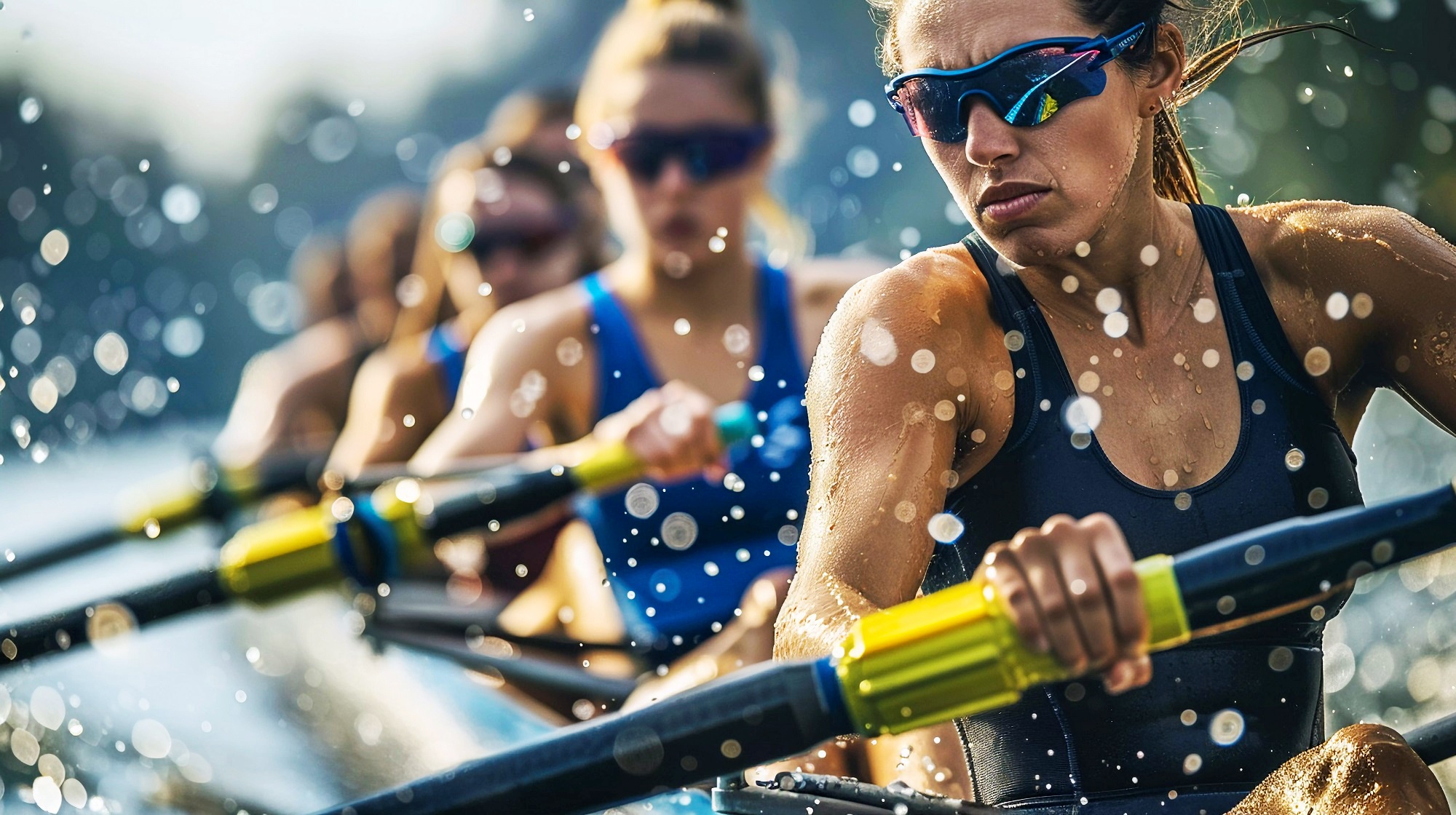
Image by magnific - AI-GENERATED ( https://www.magnific.com/free-ai-image/portrait-female-athlete-competing-olympic-games_187462233.htm )
Artigo adaptado e traduzido para o português pelos editores de OLYMPIKA MAGAZINE para republicação, conforme normas de submissão do periódico. Versão original em: https://pmc.ncbi.nlm.nih.gov/articles/PMC10357794/. LICENÇA ORIGINAL E DA VERSÃO: https://creativecommons.org/licenses/by/4.0/.
Published
How to Cite / Vancouver
Issue
Section
ARK
License
Copyright (c) 2026 Erik Baumann, Emma M C van der Vorst, Mathijs J Hofmijster

This work is licensed under a Creative Commons Attribution 4.0 International License.